
Breathing: The Pelvic Floor, Diaphragm, and Core
Full disclosure, I used to think of breathing as something that you were doing or you weren't. Fast forward to now, 19 years as a PT, with 6 years specializing in Pelvic Health and I cannot believe how wrong I was.
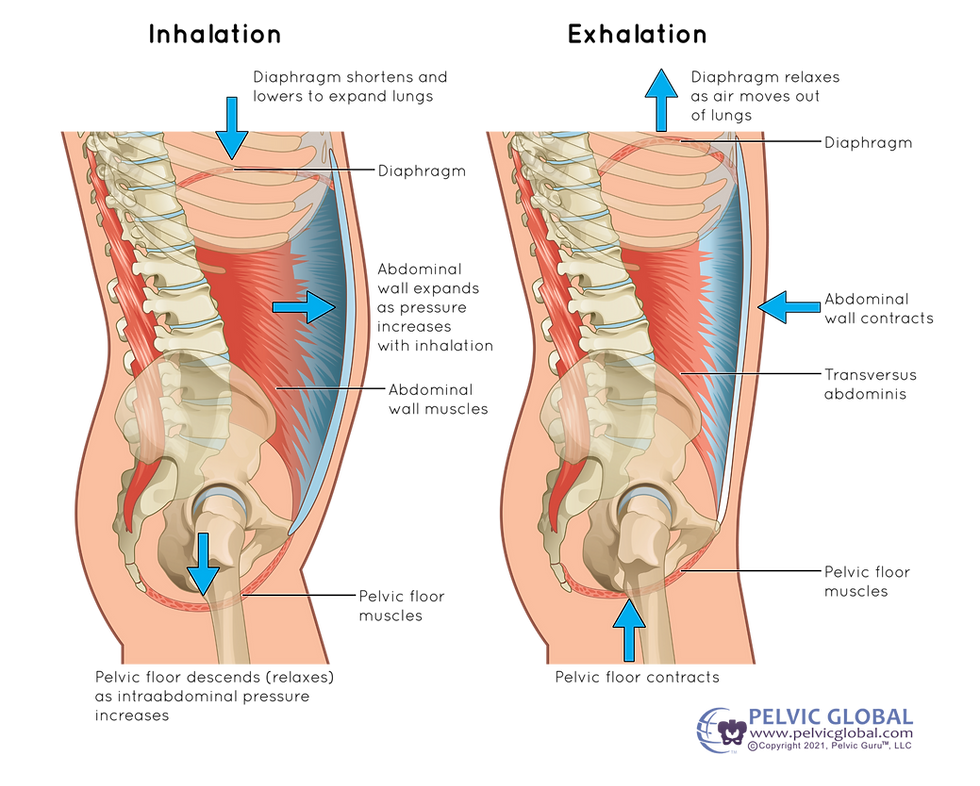
Just the mechanics of an inhale - the diaphragm lowering to expand your lungs, the abdominals expanding to allow for the air to push the guts down, and the pelvic floor lengthening - followed the by reverse to exhale - creates our own sump pump effect inside our bodies. It is almost like an accordion - but from top to bottom and then front and back. This helps with abdominal bloating and lymphatic drainage. It also creates a mechanical pump to help with digestion and gut motility. AND with normal breathing patterns, you calm your nervous system, tapping into your rest and digest or parasympathetic nervous system.
So what's the big deal?
Unfortunately, most of us do not have normal breathing patterns. Many people take shallow breaths, not allowing the air to come fully down, the belly to come out or the pelvic floor muscles to relax and lengthen. This limits our body's ability to help with lymphatic drainage, gut motility and activation of our parasympathetic nervous system.
How Are You Breathing?
Lie in a quiet room in a comfortable position with your hands resting on your stomach. Allow your body to "just be" or "just breath" for at least 3 minutes. Then begin to observe what is happening.
Do your hands move up and down?
Does your rib cage rise and you lose sight of your hands?
Can you bring your breath into your belly and down to your pelvic floor?
Place your palms on the back of your rib cage, can you breathe into the back body?
Improve Breathing Patterns

Open Your Rib Cage and Diaphragm
Chest openers such as supine twist, doorway stretch, or lying over a bolster or ball help to improve thoracic spine and rib mobility and release tension from the diaphragm.
Make Room for Air

Opening the front of your body and your pelvic floor makes more room for the air to travel down.
Low lunge stretch with arm reaching overhead, or a prone push up will stretch the hips and abdominals.
Child's pose or hands and knees can be helpful to relax the abdominals, using gravity to pull down. These positions are especially helpful with pain and bloating, where the abdominals can be restricted and tender.
Belly breathing for 3 minutes prior to eating preps your gut for digestion, helping with bloating and constipation.
Practice! Set aside time throughout the day (maybe prior to meals) to practice breathing patterns so that they become more natural and effective through the day.


